Me and Renzo are working on a paper on how to automatically create fun racing tracks. And not only that, but racing tracks that are fun just for you - which means that we must first model how you drive with a neural network, and then use this model of your driving to create the tracks.
Grand plans, but will it work? Well, we'll see soon. In the meantime, here's a question for all of you: what exactly is it that makes a racing game fun? And what is it that makes a particular track/circuit in racing game fun?
Of course, in the end we want some quantitative measure we can put into our code, but the quantitative part is really up to us. What we're looking for right now is suggestions, ideas. Any sort. What makes racing fun? Please leave your comment below!
Monday, May 15, 2006


Wednesday, May 10, 2006
Slashdotted! (Well, sort of...)
I posted a question to Ask Slashdot a few days ago, which recently got up on the front page and has at the time being had 190 replies:
What Would You Like to See from Game AI?
(Incidentally, it seems to have generated quite a bit of traffic to this blog as well...)
So what can I say about the answers? Well, there seems to be a lot of variance in what people want, or think they want. The two most common requests are AI that learns (from the player, or from past behaviour) or just "lives its own life", and AI whose reasoning is understandable/transparent/believable. While I certainly agree with the learning and adaptation bit - that is very much what I am working on - I am not so sure about the other request. Architectures that learn are generally not very good at explaining why they do what they do, but usually very good at coming up with behaviour you didn't expect when you designed them.
Do people really want to understand why agents in games do what they do? And to what extent? Surely it becomes boring when you can predict every move of your opponent, but I suppose a game where the opponents act seemingly randomly is not so fun either. Maybe there's a tradeoff. But then again, isn't there a difference between seemingly random behaviour, and seemingly random but obviously effective and therefore somehow goal-directed behaviour? The sort of difference that makes people go to great lengths to understand the behaviour?
Of particular note is the poster who complained about racing games that adapt their difficulty level to the human player, and thus ends up winning in the last lap however well you drive. But that's not AI. That's just adapting a difficulty setting. A game that not just adapted to your skill, but instead adapted to counter your particular driving style, would be much more interesting. And you would learn more from it.
What Would You Like to See from Game AI?
(Incidentally, it seems to have generated quite a bit of traffic to this blog as well...)
So what can I say about the answers? Well, there seems to be a lot of variance in what people want, or think they want. The two most common requests are AI that learns (from the player, or from past behaviour) or just "lives its own life", and AI whose reasoning is understandable/transparent/believable. While I certainly agree with the learning and adaptation bit - that is very much what I am working on - I am not so sure about the other request. Architectures that learn are generally not very good at explaining why they do what they do, but usually very good at coming up with behaviour you didn't expect when you designed them.
Do people really want to understand why agents in games do what they do? And to what extent? Surely it becomes boring when you can predict every move of your opponent, but I suppose a game where the opponents act seemingly randomly is not so fun either. Maybe there's a tradeoff. But then again, isn't there a difference between seemingly random behaviour, and seemingly random but obviously effective and therefore somehow goal-directed behaviour? The sort of difference that makes people go to great lengths to understand the behaviour?
Of particular note is the poster who complained about racing games that adapt their difficulty level to the human player, and thus ends up winning in the last lap however well you drive. But that's not AI. That's just adapting a difficulty setting. A game that not just adapted to your skill, but instead adapted to counter your particular driving style, would be much more interesting. And you would learn more from it.
Thursday, April 27, 2006
Evolutionary car racing videos
I've put up a few videos of our evolved car racing controllers. The fascinating thing is that no human has told the cars you will see below how to drive, or indeed how to maneuver aggressively so that competitors crash into walls. Instead, me and Simon used evolution strategies (similar to genetic algorithms) to evolve neural networks (sort of simple simulated brains) that control the cars. It's plain simple survival of the fittest - we start with random networks, and see who can drive the car furthest in a set time. To start with, all of the networks are pretty bad, but some are less bad than the others, so we allow them to "reproduce" (being copied) with small changes, and repeat the process... Just like in nature, this seemingly random process produces seemingly intelligent behaviour.
To start with, this is a single car driving one of the standard tracks:
The inputs to the neural networks are sort of simulated rangefinder sensors (e.g. ir or sonar) as shown below, the network is a three-layer MLP (probably the most common type of neural network), and the outputs are motor and steering commands:
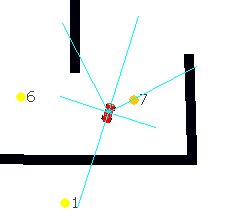
The paper detailing the original experiments, where we compared neural networks and rangefinder sensors with other architectures, is here. A follow-up paper, where we evolved cars to be able to drive several different tracks, is here. This was done by evolving the network to drive the car on one track, and then step by step letting the network teach itself new tracks. There are many tricks to making this work properly, such as starting with fixed sensor positions but later letting the evolutionary process handle the positioning of the sensors.
Most recently, we submitted a paper (not available online yet) to the conference PPSN about co-evolving several cars to drive against each other. Have a look at the following:
We did notice a few interesting things concerning the interaction of the cars in the course of the experiments. One was that what went into the fitness function - in other words, what we rewarded the neural networks for doing - had a drastic effect on the cars' behaviour. If we used a fitness function where the neural network was rewarded for its car being in front of the other car, regardless of how far along the track it was, we often saw some pretty aggressive driving with cars actively crashing into each other and trying to force each other off the track. If, on the other hand, we rewarded the networks just for getting far along the tracks, the cars usually avoided collisions. Check out the following examples of vicious neural network-drivers:
The last example shows that we still have some way to go: sometimes the outcome of the race is that both cars find themselves stuck against some wall. So far, the cars haven't found out how to back away from a wall and resume the correct course. We're working on more complex neural networks and sensors to overcome this.
Of course, I hope that these technologies will some day be incorporated into actual racing games (which shouldn't be impossible, looking at the sorry state of most game AI) and physical vehicles. But along the way, I think there is a lot to be learned about how the evolution and learning of behaviour works, and I think that games are the ideal environment for doing that research in. More on that in a later post.
To start with, this is a single car driving one of the standard tracks:
The inputs to the neural networks are sort of simulated rangefinder sensors (e.g. ir or sonar) as shown below, the network is a three-layer MLP (probably the most common type of neural network), and the outputs are motor and steering commands:
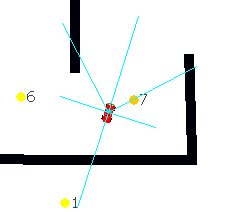
The paper detailing the original experiments, where we compared neural networks and rangefinder sensors with other architectures, is here. A follow-up paper, where we evolved cars to be able to drive several different tracks, is here. This was done by evolving the network to drive the car on one track, and then step by step letting the network teach itself new tracks. There are many tricks to making this work properly, such as starting with fixed sensor positions but later letting the evolutionary process handle the positioning of the sensors.
Most recently, we submitted a paper (not available online yet) to the conference PPSN about co-evolving several cars to drive against each other. Have a look at the following:
We did notice a few interesting things concerning the interaction of the cars in the course of the experiments. One was that what went into the fitness function - in other words, what we rewarded the neural networks for doing - had a drastic effect on the cars' behaviour. If we used a fitness function where the neural network was rewarded for its car being in front of the other car, regardless of how far along the track it was, we often saw some pretty aggressive driving with cars actively crashing into each other and trying to force each other off the track. If, on the other hand, we rewarded the networks just for getting far along the tracks, the cars usually avoided collisions. Check out the following examples of vicious neural network-drivers:
The last example shows that we still have some way to go: sometimes the outcome of the race is that both cars find themselves stuck against some wall. So far, the cars haven't found out how to back away from a wall and resume the correct course. We're working on more complex neural networks and sensors to overcome this.
Of course, I hope that these technologies will some day be incorporated into actual racing games (which shouldn't be impossible, looking at the sorry state of most game AI) and physical vehicles. But along the way, I think there is a lot to be learned about how the evolution and learning of behaviour works, and I think that games are the ideal environment for doing that research in. More on that in a later post.
Saturday, April 22, 2006
This is me
Last summer, I volunteered to be a subject in some BCI (Brain-Computer Interface) research. Hinrik, an MSc student I also used to go out and get drunk with (and try to avoid fighting with squaddies, but that's another story) was doing a project on robot control via EEG. He fitted lots of electrodes on my head, and I had to think of moving (without moving) while watching a robot move. This is what I looked like:
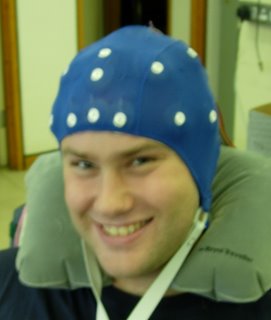
Nice, eh?
BCI is definitely an interesting field, and the BCI group here at Essex seems to contest of thoroughly nice (and competent!) people. I wouldn't mind being more involved in such research...
...but no, I have enough to do as it is. And I'm quite happy with what I do.
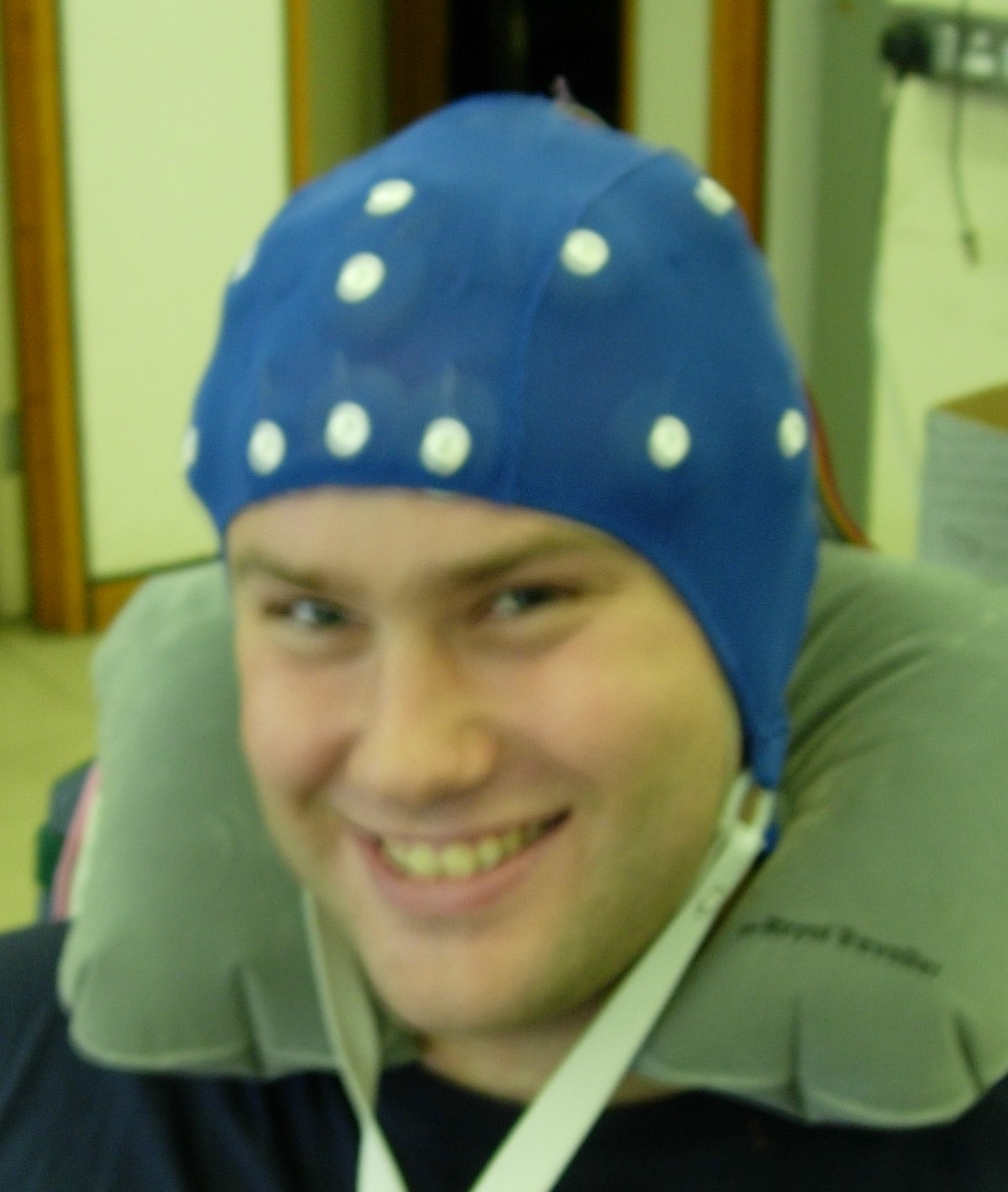
Nice, eh?
BCI is definitely an interesting field, and the BCI group here at Essex seems to contest of thoroughly nice (and competent!) people. I wouldn't mind being more involved in such research...
...but no, I have enough to do as it is. And I'm quite happy with what I do.
Evolutionary sudoku solving
Alberto, me, and Simon recently got our paper on evolutionary sudoku solving accepted at CEC 2006. We thought we were the first researchers in the world to apply evolutionary algorithms to Sudoku, but according to one of the reviewers, we actually came second, as another paper on EC and Sudoku was accepted to Euro-GP a month or so earlier.
Anyway, our experiments worked really well. A quick introduction, for those who don't think in terms of evolutionary algorithms: We start with the empty sudoku grid, empty except for the fixed positions that define the puzzle. The algorithm, in its very simplest version, then fills in the empty positions with random numbers between one and nine. At each generation, a random change (mutation) was made to each grid, by changing one of the non-fixed numbers to another random number between one and nine. At the end of each generation, the fitness of each grid was evaluated by counting the number of unique elements in each row, grid and square. The grids with highest fitness were kept for next generation, and those with lower fitness were replaced with mutated clones of those with higher fitness, just like in nature. After a number of generations, such an algorithm actually solves most, if not all, Sudoku problems!
Not that our evolutionary algorithms solved sudoku grids faster than existing methods that take into account the structure of the problem - it is doubtful whether evolution will ever do that, at least for standard-size grids. But our main aim was to verify some predictions from Alberto's theory using Sudoku as a testbed.
Alberto's theory is about geometric crossover. In my description I omitted crossover - when a new individuals (in this case a new Sudoku grid) is created by mixing two parents (in this case two other Sudoku grids). Actually, many evolutionary algorithms don't use crossover, because it is so tricky to get it right - it can easily end up doing more harm than good. But when it's used right it can actually improve the efficiency of an evolutionary algorithm dramatically. The highly mathematical theory of Alberto is about exactly what sort of crossover is appropriate for what problem representation. Greatly simplified, it says that the offspring should be somewhere between its parents in the multidimensional space of representations. And it turned out that the crossover operators designed according to this theory indeed were very effective.
But enough about this - go read the paper to get to know more! The source code is available if you want to do your own experiments.
Anyway, our experiments worked really well. A quick introduction, for those who don't think in terms of evolutionary algorithms: We start with the empty sudoku grid, empty except for the fixed positions that define the puzzle. The algorithm, in its very simplest version, then fills in the empty positions with random numbers between one and nine. At each generation, a random change (mutation) was made to each grid, by changing one of the non-fixed numbers to another random number between one and nine. At the end of each generation, the fitness of each grid was evaluated by counting the number of unique elements in each row, grid and square. The grids with highest fitness were kept for next generation, and those with lower fitness were replaced with mutated clones of those with higher fitness, just like in nature. After a number of generations, such an algorithm actually solves most, if not all, Sudoku problems!
Not that our evolutionary algorithms solved sudoku grids faster than existing methods that take into account the structure of the problem - it is doubtful whether evolution will ever do that, at least for standard-size grids. But our main aim was to verify some predictions from Alberto's theory using Sudoku as a testbed.
Alberto's theory is about geometric crossover. In my description I omitted crossover - when a new individuals (in this case a new Sudoku grid) is created by mixing two parents (in this case two other Sudoku grids). Actually, many evolutionary algorithms don't use crossover, because it is so tricky to get it right - it can easily end up doing more harm than good. But when it's used right it can actually improve the efficiency of an evolutionary algorithm dramatically. The highly mathematical theory of Alberto is about exactly what sort of crossover is appropriate for what problem representation. Greatly simplified, it says that the offspring should be somewhere between its parents in the multidimensional space of representations. And it turned out that the crossover operators designed according to this theory indeed were very effective.
But enough about this - go read the paper to get to know more! The source code is available if you want to do your own experiments.
Subscribe to:
Posts (Atom)


